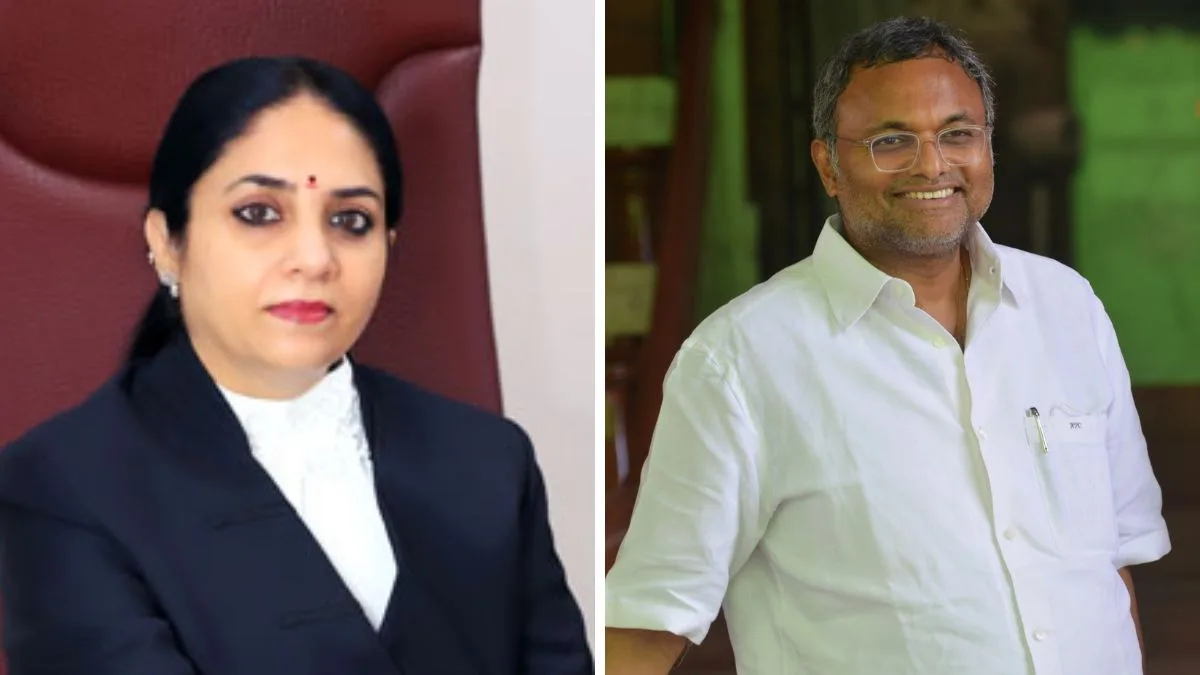
Justice Swarana Kanta Sharma of the Delhi High Court on Wednesday recused herself from hearing a plea filed by Congress MP Karti Chidambaram seeking to quash a CBI case linked to the alleged Diageo Scotland bribery matter.
The matter will now be placed before another Bench, subject to directions of the Chief Justice, the master of the roster. The development comes at a time when the court is also hearing high-profile matters involving AAP leaders Arvind Kejriwal and Manish Sisodia, both of whom have raised concerns over recusal in separate proceedings.
Advertisement
Chidambaram has challenged the FIR filed by the Central Bureau of Investigation on January 1, 2025, which accuses him of using his influence to help lift a ban on duty-free whisky sales linked to Diageo Scotland.
According to the agency, the FIR includes charges of criminal conspiracy, cheating and use of forged documents under the Indian Penal Code, along with provisions of the Prevention of Corruption Act. The case centres around alleged illegal gratification routed through Advantage Strategic Consulting Pvt Ltd, a company said to be linked to Chidambaram and his associate.
What the CBI alleges in the Diageo case
The CBI has claimed that its inquiry uncovered suspicious payments made by Diageo Scotland and other entities to Advantage Strategic Consulting Pvt Ltd, suggesting a wider conspiracy. These payments, the agency alleges, were disguised as consultancy arrangements and involved questionable financial transactions.
Chidambaram calls FIR ‘political vendetta’
Chidambaram, however, has denied the allegations and described the FIR as a case of “political vendetta”. Through his plea, he has argued that there was an unexplained delay in registering the FIR.
He has also argued that the allegations relate to the period between 2004 and 2010, while the FIR was lodged only in 2025, pointing to a delay of nearly two decades.
His counsel, Advocate Arshdeep Singh Khurana, submitted that mandatory prior sanction under Section 17-A of the Prevention of Corruption Act was not obtained before initiating the probe, making the investigation procedurally flawed.
The plea also contends that Chidambaram was not called for any preliminary inquiry and that the FIR does not name any specific public servant allegedly influenced by him. He has further submitted that there is no allegation that he either demanded or accepted any bribe or illegal gratification, and therefore, offences under the Prevention of Corruption Act are not made out against him. It also claims there is no prima facie evidence backing the charges.
Recusal pattern and Kejriwal-Sisodia angle
This is not the first time Justice Sharma has recused herself from a matter involving Chidambaram. Earlier, she had stepped aside from hearing his plea in the alleged Chinese visa case.
The judge has also recently been at the centre of recusal requests in the now-scrapped excise policy case, where Kejriwal and Sisodia had sought her recusal. While the court declined to step aside in that matter, both leaders later indicated they would not participate further in the proceedings, citing loss of faith.